

The Six-Party Conference
Arc Six: Cast of Characters
● The Library-City Dungeon
A tower-type dungeon atop a hill a little over 100 m high, in the uninhabited wasteland of "Adachi," built by stacking up a great many libraries. It has no official dungeon name. For its cumulative gained energy, its scale is quite outsized.
Type: Library (produces books, newspapers, and magazines)
Scale: 482 tier-groups / 3,520 floors / 15 km tall / total floor area 6.4 million m²
※ The floor count rises a little higher depending on how one counts penthouses, attics, or underground machine rooms.
Number of monsters: 8 (all Named)
Unique laws: no open flame inside buildings; no unauthorized entry to the Core Room and the like; can maintain a living environment free of altitude sickness even on the high floors?
【The Dungeon Master】
Has no name at all. First-person pronoun: "I". A Beast. A shut-in, but not a NEET.
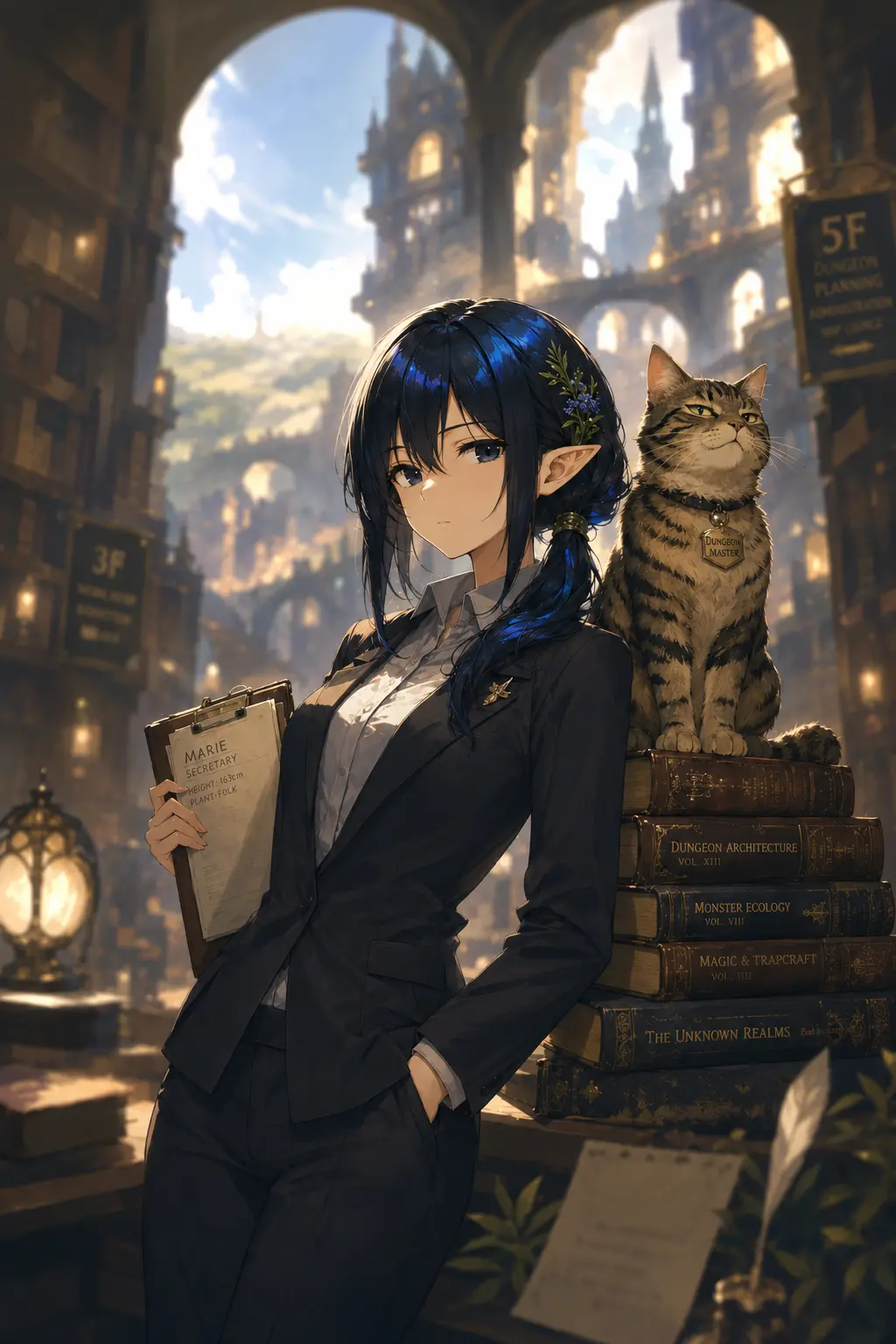
【Marie】
A Rosemary Asura. First-person pronoun: "I". Her name is "Rosemary" hacked down to size.
Just slightly on the tall side (163 cm). She has black hair with a blue metallic sheen (structural color) gathered into a single bunch, and pointed (not long) ears. Her skin is white and her eyes are a deep, bluish black (a black darkened with blue). She dresses as a woman, but strictly speaking she has no sex.
Her self-styled court rank is Director of Books. As her surname she uses "Shiso," the family name (= the name of the botanical family).
【Mint】
A Mint Asura.
Androgynous, and somewhat short (158 cm). Her short hair is a bright-green green with a metallic sheen (structural color), and her eyes too are a vivid, bright green. Her skin is pale brown.
A super-peppermint, she handles chiefly science and technology and manages the computer systems.
She divides the work among twelve duplicates. The duplicates look male, or female, or indeterminate.
【Anne】
A Lavender Asura. Her name comes from "the sort you often find on a maid."
Tall (174 cm) and slender, with black hair of a pale-purple metallic sheen (structural color), and eyes of a deep purple verging on black.
Her standard outfit is a plain dark-green long dress with a white apron and cap. Her job is to look after the Master, Marie, and Mint "and the rest," who have no aptitude for daily life.
【Sapien-sensei】
A Sage Asura. First-person pronoun: "I". His name was made by translating the English name "Sage" (which is spelled the same as "sage," meaning a wise man) into the Latin "Sapientum," then hacking it down to size.
Of average height (167 cm). His hair is gray with a faint touch of green and a metallic sheen (structural color), the base color being gray. His eyes are a greenish gray. He is got up as a man and has a middle-aged-fellow air about him, but of course he has no sex.
He handles chiefly medicine and education.
【Rāja】
A Basil Asura. First-person pronoun: "I". Her name was made by translating "basileus," the etymological root of "basil," into Sanskrit, the language of its place of origin.
Tall (165 cm) and lean and muscular. Her vivid, deep-green hair has a metallic sheen (structural color) and reaches nearly to her waist. Her eyes are black (a black deepened with green). Her skin is brown.
A warrior-general who is fond of the naginata and of horseback riding, she handles chiefly military affairs and administration.
【Scarlet】
A Salvia Asura. Her name comes from the English name "scarlet sage."
Long-ish black hair of a deep-green metallic sheen (structural color), eyes of a vivid red, and an appearance that looks female.
Sales.
【Kinran】
A Coleus Asura. His name comes from its alternate name, "gold-brocade shiso" (kinran-jiso).
Short hair of a metallic sheen (structural color) that turns red or yellow depending on how the light strikes it, eyes of a pale purple, and an appearance that looks male. His outfit is sometimes a flashy, garishly colored suit, sometimes an aloha shirt.
Sales.
【Farigole】
A Thyme Asura. Her name comes from the way thyme is called in southern France.
Deep-green hair, near black, with a greenish metallic sheen (structural color); eyes of a black tinged faintly with pink. Small in stature, though that does not particularly make her look like a child.
A newspaper reporter. Holds a curator qualification. Not a librarian.
● The Dungeon's Residents
【Okada Tarōzaemon】
The caretaker of the settlers. A half-bald man. His usual first-person pronoun is "I", but with his betters he uses "I".
Poor at reading and writing, but in the thick of fierce training.
【Commander Kishi】
Kishi Harima-no-suke.
The head of the warrior band the "Kishi Band." His first-person pronoun varies among "I" and so on, which is common enough among the people of this world.
【Haruna】
A horse-beastfolk (horse-legged) girl from the Land of Ke. The daughter of Oguri Kōzuke-no-suke (not Oguri Tadamasa), and a big eater. Her first-person pronoun is "I".
Her lower body, eyes, and ears are a horse's; her head is human. Her coat color is bay. A mare. Her face is not an animal's, but since this world counts her under the Beast Realm, she is a beastfolk all the same.
Rāja rides her, that is to say, rides in the carrier-frame on her back. Quite fleet of foot (slower than a racehorse, naturally).
【Kasumi】【Tsukuba】
A pair of horse-beastfolk sisters from the Eastern Land. Their lower bodies, eyes, and ears are a horse's; their heads are human. Kasumi's coat is liver-chestnut, a dark reddish-brown overall. Tsukuba's coat is flaxen-chestnut, the body reddish-brown but the hair and tail blonde. Both are difficult in temperament and suited to a warrior's mount, but of differing types.
● The Land of Musashi
【The Daikan】
Yoshida Nishinoichinojō.
A pompous middle-aged man. He is on the taller side for this region, but only about 1.7 m, by no means a giant of six shaku.
The Daikan (a non-hereditary lord) of the "Iruma" region to the west of the dungeon-city.
【Echizen-ya】(given name not stated)
A fuel merchant. His first-person pronoun is usually "I", but it varies with the occasion.
His dream is to deal in coal. He all but lives at the Library-City Dungeon.
【Saburō】
Hiki Komori Niedo Saburō, of no rank and no title.
The survivor of a warrior band that lived in Hiki to the northwest; his two elder brothers were killed by Marie.
● The Land of Sō
【The Envoy of Sō】
The presenter of Sō, Okamoto Shuyu-no-kami. The envoy of the lord of the realm, Kazusa-no-suke.
● The Land of Ke
【The Tanuki-Beastfolk】
The District Governor of Gunma County, Takahashi Tsushima-no-kami. A big old tanuki. Female.
【Asama】
A horse-beastfolk mare. One of the Four Heavenly Kings of big-eater horses.
● The Eastern Land
【The Castle-Lord of Oda】
Oda Ukyō-no-suke. The young castle-lord of Oda. His given name is Nobuharu.
● The Land of Sumō
【The Tea-Server Monk】
Daizen-no-suke Nyūdō Shōtō. A monk.
He comes riding a camel.
● Bonus: Malthus-Darwinism
Plants, for the most part, either multiply endlessly or scarcely grow at all, and yet for some reason the rosemary in the garden "grows well and blooms in great quantity, but won't propagate from seed at all." That is the source of the idea. The punchline is presumably that it's triploid, or self-incompatible and needs a pollinating partner.
The ring of the term is borrowed from Marxism-Leninism.
A doctrine aiming at the "selective breeding of humanity" through population suppression based on Malthusianism, the theory of social evolution based on Social Darwinism, and further the joining of eugenics and genetics. Primitive eugenics included examples that argued things like "the disabled and criminals ought to be sterilized," but of course neither disability nor crime is necessarily a matter of heredity, and even where heredity is involved it is not necessarily a "heredity harmful to mankind." That point is the setting: not scientific socialism but scientific eugenics.
That said, when one tries to render it into concrete social policy in modern society, it turns out to be rather difficult. After all, when it comes to "genetically superior," it is hard to pin down the criteria by which any given trait is "superior." Even a hereditary criminal, depending on how he is raised, may in some cases turn out to be a fine, capable person held in good repute. The criteria are harder than for a difficult-tempered famous racehorse. Crossing Goldsmith (a pseudonym) with Sleep Tōjō (a pseudonym) does not, as it happens, yield an outrageously fine racehorse. And even with humans, trying to use sheer annual income as the criterion, that is shaped more by supply and demand than by ability.
The Malthus-Darwinist party is, naturally, named the "Evolution Party."
One offshoot (?) of it is the argument that the family system should be abandoned, and that one should select a "stud-man," a human stud in place of a stallion, to do the breeding. Since a harem, fine as it may be in a novel, would almost certainly turn into a bloodbath in reality, this is not polygamy: each woman heads a fatherless household, and the stud-man is of no use except at breeding time. The name would be something like the "Livestock Party." A "Stockbreeding Party" would lean more toward promoting the stockbreeding industry.
Another direction is the argument for aiming at true eusociality, like the naked mole-rat; the term of abuse for it is, naturally, the "Termite Party." The "True Society Party," for "denying the institution of private property," draws ten years' penal servitude in a world that has a Peace Preservation Law, together with the Republican Party (which, needless to say, would "alter the national polity").
Incidentally, Japan has a noted advocate of eugenics who was even awarded the Legion of Honour at the rank of Commander, but as seventy years have not yet passed since his death, I shall refrain from citing him. A mere Chevalier, on the other hand, you can find lying about all over the place.