

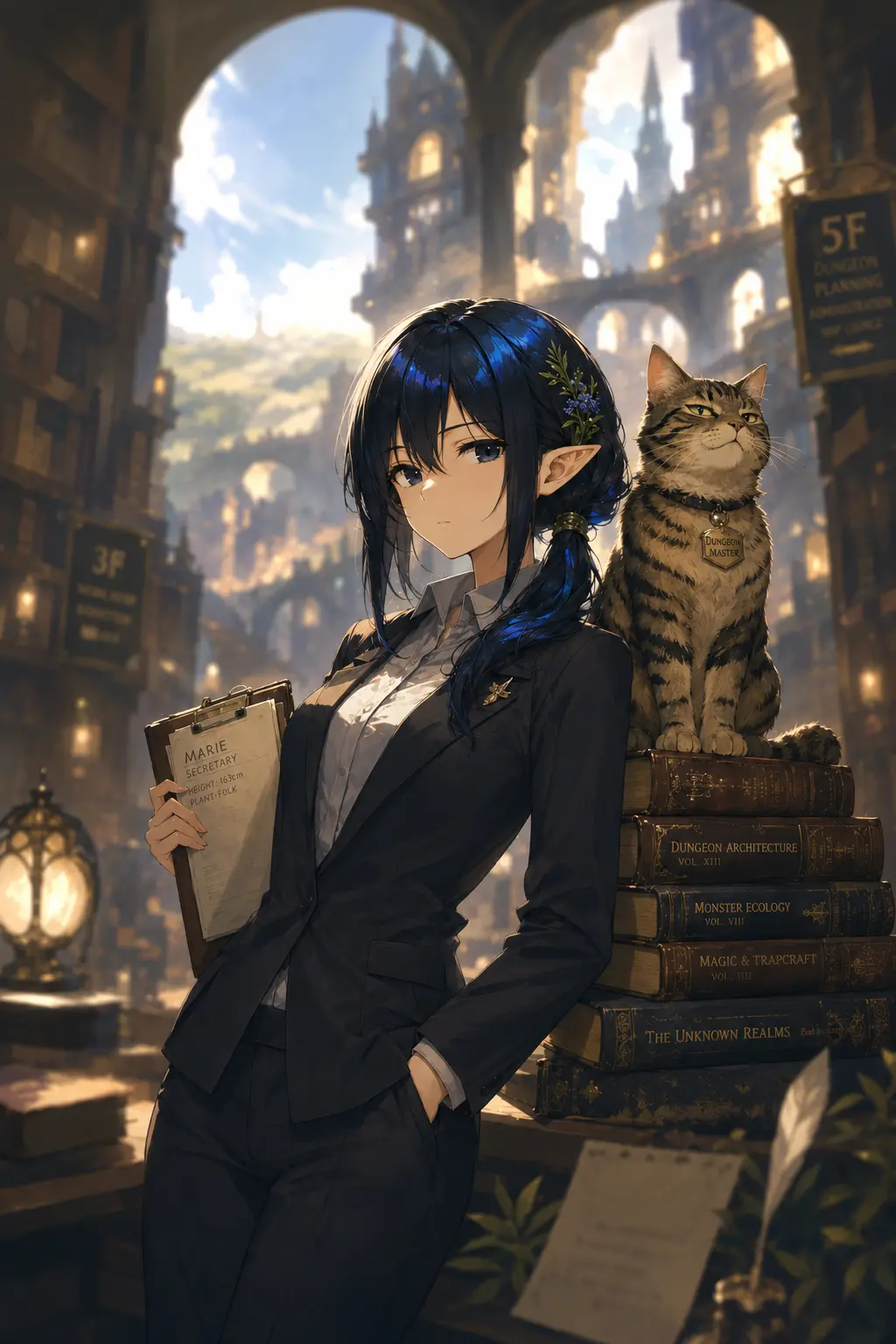
Boso Runs Wild
Let's Summon an Elementary School and Repurpose It as a Farming Village
[Core Room]
"As in the earlier plan, each village will be on the scale of an Edo-period one, around fifty to eighty households, with a population of two hundred to four hundred. Most elementary schools are eight grades, an ordinary elementary school and a higher elementary school combined, and besides the library they have a staff room, a science room, a music room, and so on, so one way or another they generally come with twenty or thirty classrooms. So if we summon two or three elementary schools per village, that's one classroom to a household, with the auditorium serving as the village's shared storehouse. Or a large school with six ordinary classes and four higher classes, since roughly two in three go on to the higher elementary school, makes a single village all by itself."
"Or shall we mix in some middle schools too. One way or another there must be about a thousand of them across the country. Middle schools."
"Around seven hundred, I believe. Add in the girls' higher schools and it comes to some two thousand. Though it seems private schools can't be summoned, which cuts the number further."
"Same as the libraries, then."
"The same, surely. The Imperial Library is of course a national institution, but everything else belongs to local bodies, prefectural and municipal offices and the like, and privately run libraries can't be summoned. Strictly speaking, they appear on the summon list, but are displayed in an un-summonable state. Even one inside an apartment block or a shopping mall can be summoned building and all, so long as it's a branch of a city library."
"Is it that, with private ownership, the question of rights gets complicated?"
"I don't think that's it. At any rate, even when you summon a school, everything but the library comes without fixtures. Though if the hōanden, the imperial-portrait shrine, were to be summoned with the portrait still inside it, depending on how it was handled that could amount to lèse-majesté, so perhaps it's just as well."
A photograph printed in a newspaper or magazine, of course, is another matter entirely; there's no harm in tossing it out with the old papers, or in using one to roast sweet potatoes over a fire in a field.
"Bah. It's not as if the Saitama Prefectural Police are going to turn up in another world."
"So then, as for elementary schools used not merely as buildings but actually run as schools, in farming districts one is usually set up for every three to five hundred households, which works out to one per five or six villages. But because the farmland here is comparatively spread out, the distance to school grows long as well, some three or four kilometers."
"When we get an elementary school running, it might be best to have school buses, like in America. And as for the summoned elementary schools, even if we fetch the textbooks through the library's functions, at the very least I'd like the desks, chairs, and stationery to come as a set."
"We'll have no choice but to make do with the library's desks and chairs. But more to the point, we can't open an elementary school at all unless we do something about teachers."
"Shall we build a normal school?"
"Even supposing we could provide the building, we have no teachers to train the teachers. It's a case, as it were, of 'having no clothes to go buy clothes in.'"
"With clothes there's always mail order, but I doubt correspondence courses from another world are workable."
"Reference books and lecture materials, being things a library handles, we can summon, but we can't obtain interactivity, so there's a hard limit no matter what."
"It's a thorny one."
"The greatest problem is that, since it wouldn't be a proper, accredited normal school, the teachers would be uncertified teachers without teaching credentials."
"Credentials again. We've had no end of credential troubles in growing this dungeon up till now, too."
"The Viking settlement in Greenland collapsed because, with its sea route cut off, the bishop appointed by the Pope could not be dispatched; without a bishop no priests could be ordained; without a priest no weddings could be held; and in the end the society could no longer sustain itself. Education won't become a fatal problem as instantly as the rites of life do, but we ought to prepare some alternative to the teaching-credential problem before long."
"With the rites of life, it turns fatal instantly?"
"It does. Especially in pre-modern societies, this world included, social order cannot be maintained without religion. In this world, for instance, the temples manage the household registers. In the case of a temple, anyone may take vows, but to become a head priest one must train and earn recognition. A physician, by contrast, is no monk and has no 'credential' at all, so anyone is free to call himself one. Of course, a physician licensed by a master carries authority, while a quack, conversely, gets cast aside, but the point is that monks are indispensable to society itself."