
Interlude: Commentary
Commentary: About the Dungeon
● Dungeon
It uses the lives and emotions of adventurers as its energy source.
Emotions alone are not enough for it to sustain itself over the long term, so a certain amount of sacrifice is required. Large dungeons require a great many sacrifices, and at the Iinuma Dungeon, not only do stray casualties turn up from time to time, but once every few centuries it claims about a thousand victims in a single mass disaster.
The greater part of any dungeon is nothing more than a cave, but some replication-summon things from one or several otherworlds, and in this region both water and air depend on the dungeon.
What a given dungeon can summon from the otherworld is, broadly speaking, fixed per dungeon. The summoning cost has the trait of being lower the more "commonplace" the item is. In the case of the Library-City Dungeon, libraries, which exist in many otherworlds, are easy to summon, and the larger a book's print run, the lower the cost. For this reason, newspapers and certain scriptures and the like can be summoned at extremely low cost.
As an offshoot of this, there is the trait that "things resembling something already summoned are easier to summon." Because of this, in the case of an academy dungeon, students and faculty belonging to the same academy can be summoned cheaply. Note that because it is replication summoning, the original world's items and people remain; in the case of death-summoning, however, what remains is a corpse.
The greater a dungeon's height differential (height or depth), the more energy it naturally acquires.
【Unique Law】
Some dungeons can warp specific laws of nature. In the Library-City Dungeon, fire cannot be used inside the dungeon's buildings, and central areas such as the Core Room are off-limits to unauthorized persons.
Apart from unique laws, when a dungeon grows large enough, the influence of geothermal heat is eased even deep underground, and beings that are physically incapable of flight, such as half-bird-folk and angels, become able to fly.
【Tier-Group】
A single grouping that makes up part of a dungeon. A single tier-group may contain multiple floors.
Tier-group sizes are wildly varied, from a single hut to the size of a plain. There are also dungeons that have no clear tier-group structure.
【Dungeon Sphere of Influence】
The range around the dungeon proper within which the dungeon's power reaches.
Other dungeons, and towns or villages already inhabited by people, cannot be swallowed up.
【Human Farm】
By having people (whether human or Beast) dwell inside the dungeon, it gathers their emotions, and by waiting for their lifespans to run out naturally, it also solves the problem of sacrifices.
In the Library-City Dungeon, it is the dungeon side that has set up the human farm, but in places like Umeda, the Mercantile City, it is the residents who run the city and have tamed the dungeon.
【Dungeon Core】
A sphere of iron-nickel alloy, one to a dungeon, rarely more. Its surface is somewhat liquid-like and lukewarm.
By destroying the Core, a dungeon can be made to collapse, and all nameless monsters vanish.
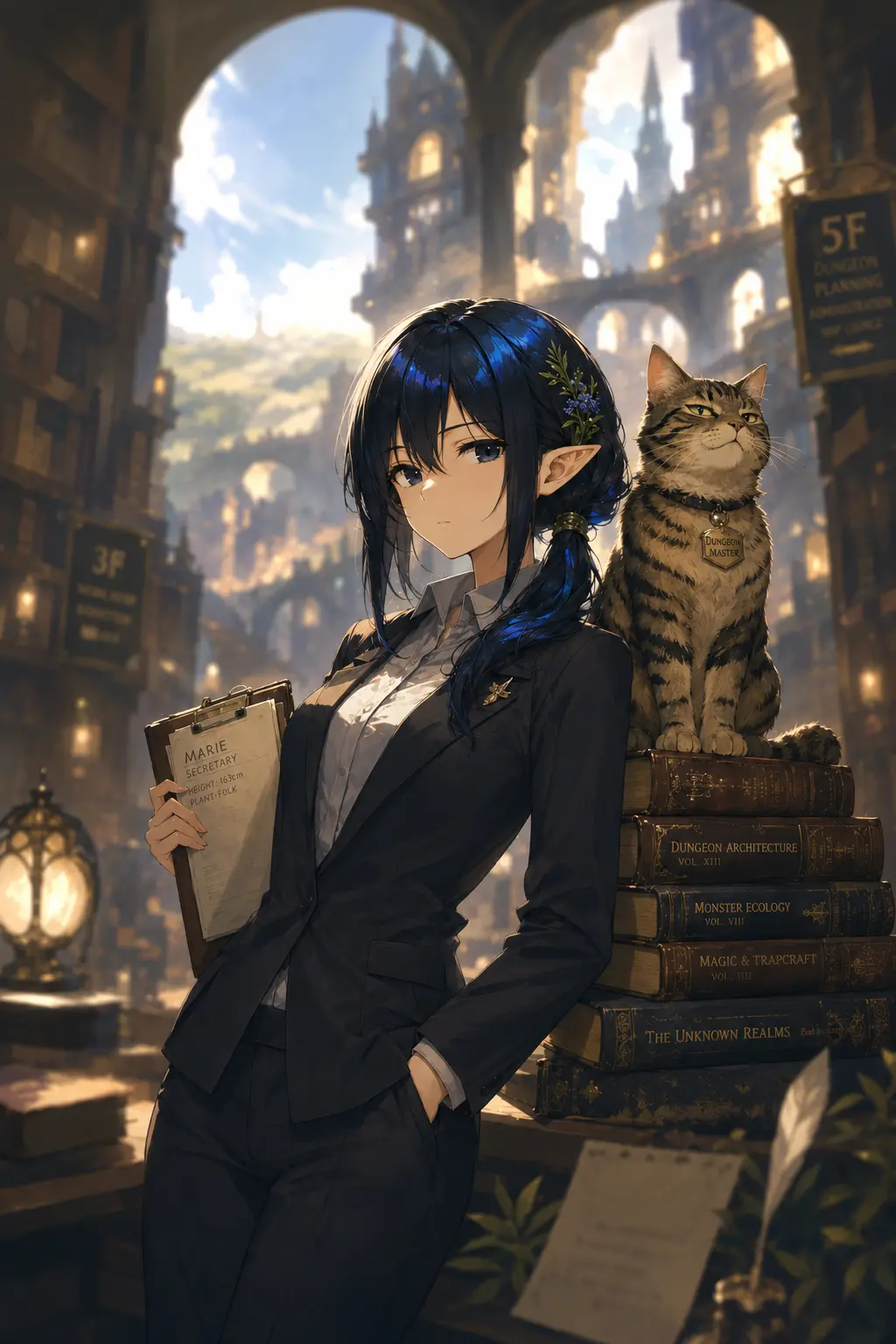
【Dungeon Master】
The administrator of a dungeon. Dungeons with an administrator are not many. As the word "Master" makes clear, an administrator may hold a Master's degree. For example, a "Business Master" would hold a Master of Business Administration. In general, cave types tend toward civil engineering, tower types toward architecture, trap-focused ones toward a Master of Engineering in mechanical engineering or applied chemistry, and operation-focused ones toward a Master of Business Administration. That said, except in cases of otherworld transfer or reincarnation, the administrator has not actually graduated from a graduate school in this world or any other; they are generated with that as a "setting."
Of course, a Master's degree is not mandatory.
【Dungeon Monster】
A "creature," meaning a living thing. Basically, a living thing whose presence in that dungeon would be no surprise: for a pirate ship, that means pirates, rats, weevils, and so on.
In reality they are not living things; they require no food or drink, and their energy is supplied by the dungeon. They cannot leave the dungeon.
Because they have no ego, they move according to the dungeon's commands, but those bred within the dungeon do not necessarily obey commands.
When defeated, they yield a drop item.
Properly speaking, the orthodox approach, for the sake of efficiently using dungeon energy, is to build an ecosystem of monsters inside the dungeon. The Library-City Dungeon, squandering the abundant energy it acquires, is an exceptional case.
【Main-Line Monster】
The species that is central to a given dungeon.
For a pirate ship, that means pirates. It may also double as the "retainers" described below.
【Artifact】
A man-made object or fixture. Non-living existences such as golems are included here.
【Retainer】
A "henchman," meaning an underling. Generally of the same race as the Dungeon Master, and all of them become named-ordinary.
In some cases they are the main-line monster itself.
【Named Monster】 & 【Named-Ordinary Monster】
A monster (or retainer) that holds a name within the dungeon system. It becomes a living thing and requires food and drink, but gains the ability to leave the dungeon. Even if killed, it can be revived with dungeon energy.
Because the numbers are limited, there are only a handful unless the dungeon is quite large in scale.
They do not necessarily possess intelligence.
Note that when one is not registered in the dungeon system, it merely means the Dungeon Master or someone is calling it by a name, with no particular significance.
【Dungeon Structure】
The dungeon itself is summoned from an otherworld and cannot easily be destroyed. Auxiliary structures of simple shape can be generated from ordinary sand and the like nearby, and are likewise hard to destroy. There is also a technique of having monsters such as moles or naked mole-rats dig holes, then designating those holes as dungeon structure.
In the Library-City Dungeon, this is used extensively for ramparts, irrigation channels, road paving, ships, and the like.
● The Reincarnated
When a soul transmigrates through the Six Realms, its memories are lost, but an "otherworld reincarnation" that retains its knowledge is theoretically possible. However, for Asura, Beasts, and Pretas, knowledge volatilizes while they are infants, making it impossible to carry over memory or knowledge, so there comes to be no difference at all from ordinary reincarnation.
It is said that "corpse-possession summoning," reincarnating the soul of a deceased person from an otherworld at the cost of a sacrifice, is also possible, but the method is unknown.