

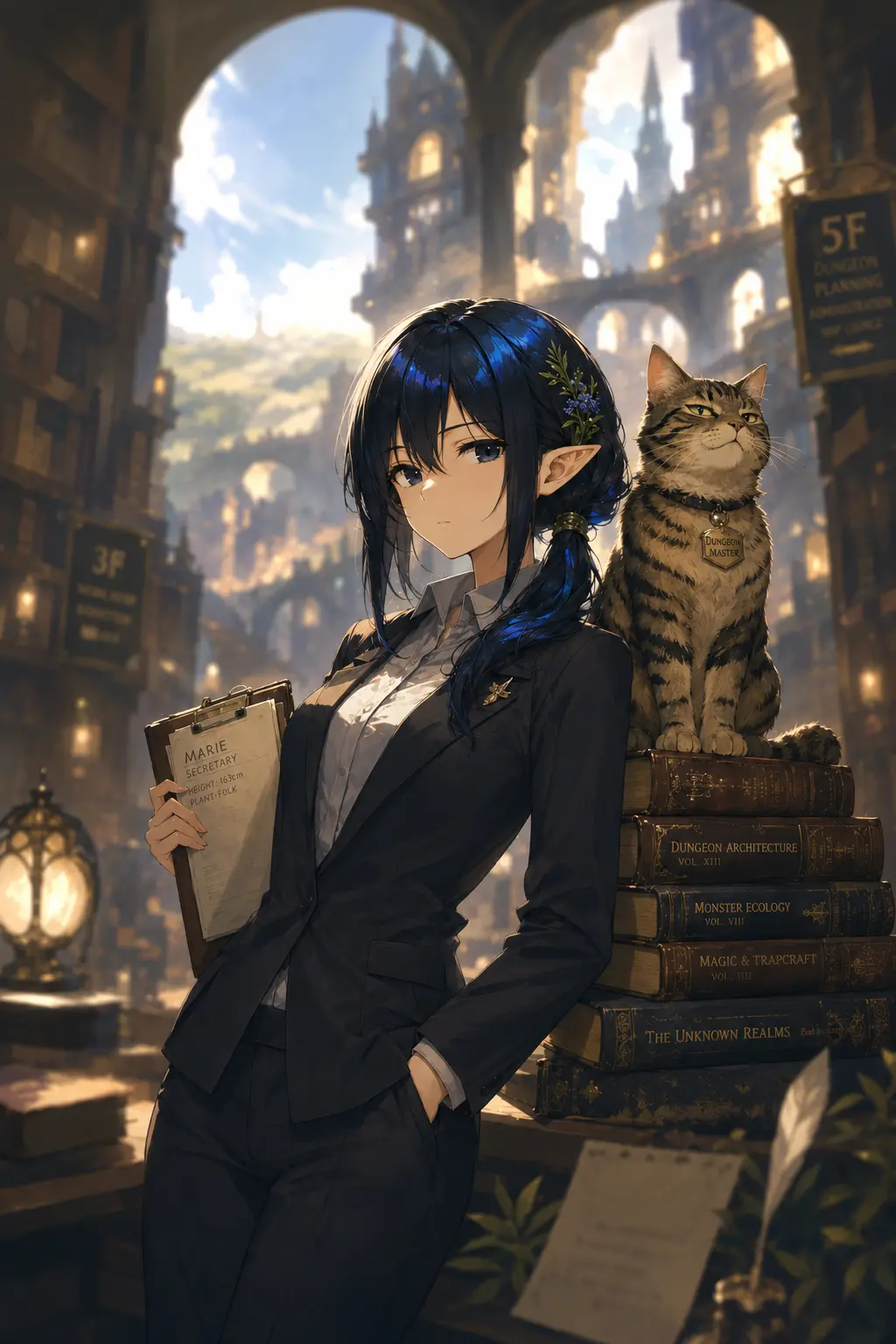
The Agricultural City Dungeon
The Second Wave of Settlers
[Core Room]
"Distance twenty thousand, headcount about a thousand, flying the banner of the Iruma magistrate's office."
"A thousand? Mint-san, the settlers were supposed to number a hundred. Isn't that a bit too many?"
"Master, any way you look at it, that's no hundred."
"Eh, an order-of-magnitude slip happens now and then. Good enough!"
"Master, it is not good enough. A thousand people, and who's going to look after them all? We'd almost do better to spring the pitfall and thin the numbers out…"
[Before the Library Dungeon]
"So you've brought me the head of John the Baptist."
Marie called out the moment she laid eyes on the magistrate.
"There are no death-row convicts to be had. But hasn't the dungeon grown larger still? Aha, I see how it is, Secretary-General-dono. You've been off eating bandits on your own."
"We were attacked by bandits, so we drove them off. Oh, and the surviving bandit gave his name as 'Hiki Komori Niedo Saburō.' It may well be a false name. Judging by the direction he came from, his stronghold lies to the northwest, within five days' march. Being a shut-in NEET, he's most likely too irresolute to flee and has stayed put."
"NEET? An insult, at any rate, I gather. The Hiki one, that frog bastard, you mean."
"Do you know something of him?"
"Hiki is a region north of Iruma. The Hiki ones are apparently a clan that lived in those parts long ago. I'll send an envoy to the magistrate over there later."
"The settlers? It'd be rude to keep them waiting, so I'll have the Maid show them to their homes. Though I do get the feeling there are a few, no, quite a few too many of them."
"From Kasumigaseki, where my office sits, and from Ikō, Tsuge, and Karase, and all across the Hiki area, I gathered up every volunteer among the farmers short of land and the men with no work."
"… Humans do have a high breeding rate, after all… Being an Asura, I'd have no qualms about culling and disposing of the surplus if humans grew too numerous, but a magistrate can't very well do that sort of thing, can he?"
"Safeguarding the people's livelihood is a magistrate's duty. A corrupt magistrate would be another matter. Mind you, directly clearing a truly dangerous dungeon is the work of adventurers, not a magistrate, though it's a rare thing indeed for a dungeon's monsters to come out into the open."
"You likely already know this much, but a dungeon's monsters draw energy (well, 'power' is the easier way to put it) from the dungeon itself. So apart from special monsters who hold names, they can't operate outside the dungeon. And since named monsters are few in number, they won't leave the dungeon unless something quite extraordinary occurs."
Incidentally, there was a dungeon that, since no adventurers ever came, pulled the stunt of having its named monsters abduct villagers and murder them inside the dungeon.
"This dungeon has no dangerous monsters, and the traps only catch bandits, so on that score you can rest easy."
"I'm rather dangerous myself, in a sense. Now then, if these thousand people 'lead healthy, cultured lives,' this dungeon will grow further still, and we'll be able to take in settlers not only from Iruma but from the surrounding Hiki and so on… and where else?"
"Around here that would be Toshima and Tama. Koma and Niiza differ in culture, so frictions might arise and make it difficult."
"Just so, we can take in settlers from those places too. And while the dungeon itself is sustained by the settlers' power, to maintain the 'organization' of the dungeon city we levy one-tenth of the harvest and of commercial transactions."
"And every day they get to eat white rice."
"They'll come down with beriberi. And what's more, from a rabble of paupers the power to be had is limited. Housing people inside a dungeon and settling them there, the way we do here, is called a 'human farm,' but when the rearing conditions are wretched, the power obtained is meager. Conversely, improve the environment and they breed without end until the whole thing collapses; that's a problem in its own right.
The original meaning is different, but there's a saying: 'A god's majesty waxes by the reverence of men, and a man's fortune is graced by the virtue of the god.'"
"The Jōei Code, is it?"
"To that end, in this dungeon we make education compulsory for the settlers, encourage employment, and weed out as far as we can the NEETs who do nothing but eat their feed and laze about, er, the freeloaders… though if the law of the worker ants holds, I suppose two in ten can't be helped."
"True enough, there are those who stay in the village even with no work to do."
"In that fashion, we raise the quality of life gradually, so having ten thousand people suddenly dumped on us would be a terrible bother."
After that, while the magistrate and Marie made idle conversation, the settlers filed into the rooms assigned to each of them, until only the magistrate and his party remained before the dungeon.
"Now then, once more, it was seed potatoes, saplings, and livestock, was it? First, when it comes to Iruma, it's sweet potatoes. The planting season is coming up, so the timing's just right. And since water is scarce and the soil is poor, there isn't much taro to be had around us, but here it ought to be possible to grow it. Its strength is that it's little trouble."
"Sweet potatoes… ah yes, satsumaimo. But for a thousand people's worth…"
"For fruit, I've brought saplings of persimmon, pear, plum, and chestnut, every variety I could lay hands on."
"I'll try to find some way to grow them faster."
"As for vegetables, I've brought Japanese pepper (sanshō), ginger, myoga, butterbur, and the like."
"Lovely."
But Marie can't tell the difference in taste.
"The only livestock is chickens. Regrettably, horses are beyond our means."
"They drink like oxen and eat like horses, after all; a horse needs a great deal of feed, so it would be difficult. We'll need horses eventually, but for the moment we ought to get a knight order ready ahead of them."
"Ho. Secretary-General-dono, as it happens I've just the lead for that."
"You mean the matter of the knight order?"
"Just so. I'll bring them along next time I come."
[Core Room]
"Master, a while ago we spoke of the 'human farm,' didn't we?"
"Ah, that we did. Was it the day Marie-san arrived?"
"In the end there's still no librarian, but I'd say it's begun functioning as a human farm in earnest. There are plenty of challenges left, mind you."
"Countermeasures against bandits, and the like. Yes. One thing and another kept pushing it back, but let's summon a military-man Shiso. Still, a thousand of them all at once. I haven't counted the exact number, mind you."
"It's about time we needed a bureaucratic apparatus, too. We may as well go for a mayor Asura. And they're still likely to keep multiplying, aren't they?"
"It really is a 'human-bomb.' Let humans settle in a garden and they breed and breed, driving out all the other races."
"They're the race that breeds best, after all."
"Indeed. In theory there are beastfolk races with high breeding rates too, but for all the saying 'multiplying like mice,' I've never once heard of mouse-beastfolk overpopulating."
In some otherworlds, there is a Nezu Park on the site of the Asaka Garrison in Saitama, and its mascot character is a mouse. (There are other famous mouse characters too, but as their copyrights haven't expired, they are omitted here.)
"True, I've never laid eyes on a beastfolk. There was only the one on the very first summoning list. And it doesn't seem there are any among this batch of settlers either…"
"Since I haven't checked them one by one, a fox or a tanuki may have slipped in among them."
Because humans have a high breeding rate, what arises is not so much the "relative surplus population" of Marxian economics as an outright absolute surplus population. Yet Marie was contriving to turn even that population to the dungeon's development.