
The Dungeon Is Born
Human Farm and the Six Realms of Reincarnation
(explanation)
[Core Room]
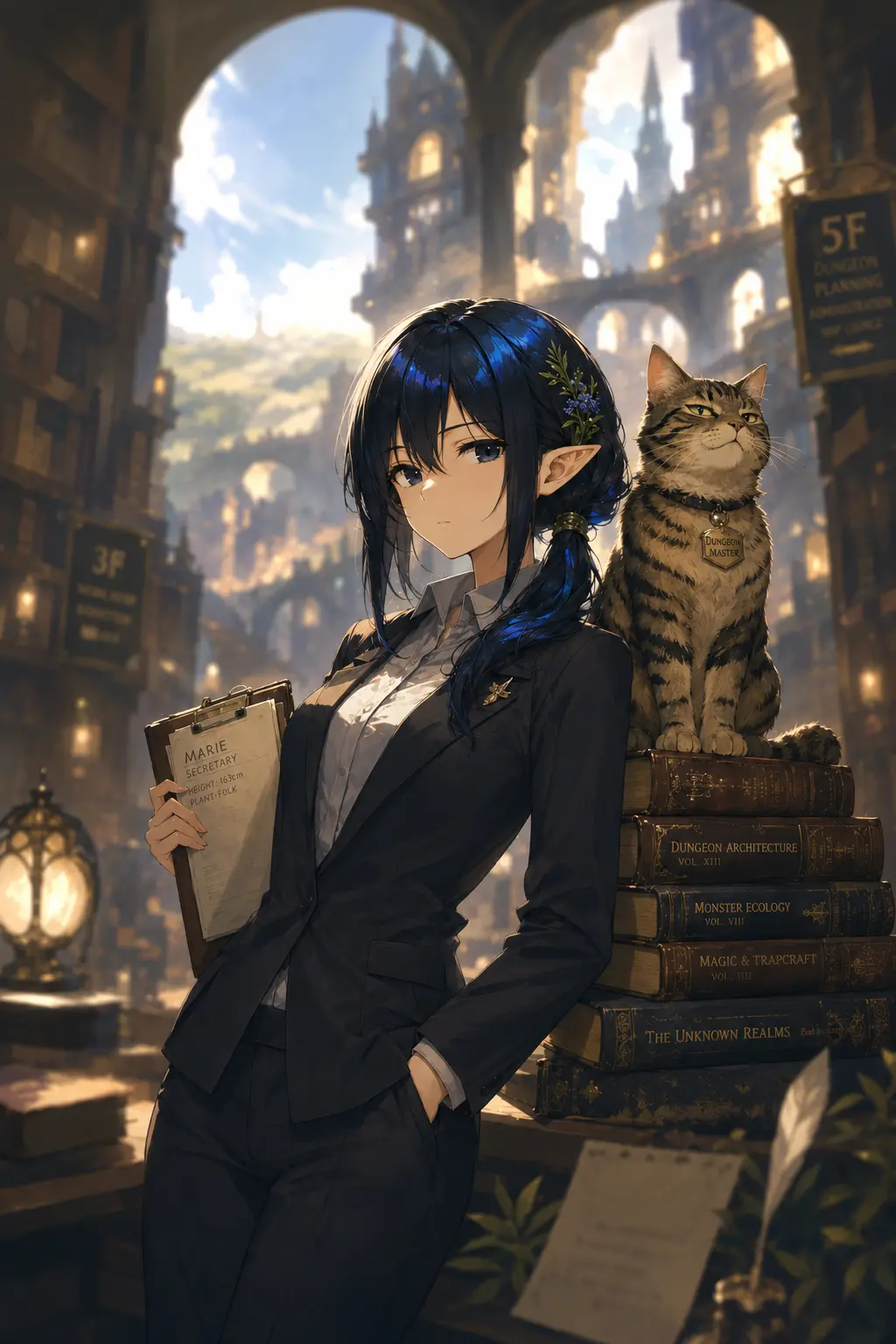
Unlike the Master, who had flung aside even the introductory manual, Dungeon 101, Marie had read the whole of the Encyclopedia Dungeonica and so had committed the fundamentals of dungeon management to memory. Whether she had actually absorbed them remained unclear.
"First, the most basic of basics. A dungeon, you see, grows by drawing energy from the emotions and the lives of intruders, who are usually adventurers. It lures them in with treasure for bait, then finishes them off with monsters and traps. Think of it as a kind of carnivorous plant."
That much, the Master already knew.
"By feeding them to the book monster, or something?"
"… For the moment, we have no monster of that sort. And, well, it seems a library is rather poorly suited to being an ordinary dungeon."
"So the question is how to defeat adventurers with books. Hmm."
"There's no need to defeat them right away. Just as a carnivorous plant can survive without eating insects, the Dungeon Core also draws power from the World Core. So even without adventurers, the dungeon can be maintained. In fact, according to the Encyclopedia, the basic approach is to run it so that it can sustain itself on the World Core's energy alone. That said, growth is difficult without adventurers."
"Defeating them is out of the question, but if there were something to stir up their emotions. Maybe."
"In the long term, I think aiming for a 'human farm' would be best."
"A human farm?"
"We settle residents inside the dungeon, humans being the obvious choice, though Asura, Beasts, or Pretas would all do just as well, and harvest their emotions."
"That's a patient sort of plan."
"As a rule, dungeons are unsuited to habitation. They're 'dim, damp places,' monster dens, after all."
"This dungeon's certainly not that."
"Because it's a library, we can secure adequate lighting and climate control. And as a property of dungeons, refuse is absorbed automatically, so it's hygienic as well, which suits a human farm. If we could just make use of the library's character, it would be ideal, but there's a grave problem."
Marie went on.
"From here on, in order to make a library dungeon actually function as a library, we'll need a specialist professional: a 'librarian.'"
"Not a Shiso, not a founder, not a secretary… well, what's done is done, and at least I didn't toss in an apostle. Good enough!"
"In the Library Hell, there was Horse-Head, and presumably Ox-Head as well, dividing the duties between them. One, or perhaps both, must have been the 'librarian.' But they've been overwritten by the original monster, 'Shiso,' so we can't summon them."
It hadn't actually been Horse-Head, but there was no longer any way to confirm that.
"And since we can't summon a librarian as a dungeon monster, the alternative is to call up a library librarian who died in another world, via 'reincarnation' or 'corpse-possession summoning.' That would be the idea, but…"
"There's a problem with that?"
"First, ordinary reincarnation, the kind where one loses one's knowledge, has nothing to do with the cause of death. Indeed, short of attaining enlightenment, a soul reincarnates upon death no matter what. But for otherworld reincarnation or corpse-possession summoning, where knowledge is retained, the cause of death should ideally be a truck, apparently. That isn't strictly required, though, so it's not a real obstacle. With death by old age, there's a danger the knowledge has volatilized, so accidental death is preferable. That's about the extent of the reasoning."
"It'd be a problem if they were too senile."
"The real problem comes next. To begin with, in the case of otherworld reincarnation, the reincarnated soul is naturally a newborn, so we'd first have to provide it parents. But this dungeon can't summon humans to serve as parents."
"Because there's nothing here but 'Shiso'?"
"Exactly. Asura reproduce by seed or by clone, just like plants, but at birth they can't assume a humanoid form and have no brain, so even if reincarnated they can't retain knowledge. Whenever it is that they 'recall' their past life, the knowledge has to be in the brain from the very start. Beasts, too, have small brain capacities, so much of their knowledge would be lost. Ox-Head and Horse-Head, of course, have the heads of an ox and a horse, so they're constrained as well. And Pretas, who begin as mere pebbles, are out of the question entirely."
Marie seemed to dislike Pretas a great deal.
"There's one more method, 'corpse-possession summoning,' which transmigrates the soul of a dead person from another world at the cost of a sacrifice. Unfortunately, the Encyclopedia Dungeonica gives no detailed procedure for it."
"That's plainly an evil ritual, isn't it."
"I should think so. And so, unless there's some other method not recorded in the Encyclopedia Dungeonica, for the time being we'll have to operate without a 'librarian.'"
Since there was a library dungeon right here, one could summon any number of books on library science, but knowledge alone wasn't going to solve everything.
"You mentioned a human farm just now, but couldn't we use livestock that grow faster and live shorter lives? The very last entries on the summon list, the deathwatch beetle, the booklice, the silverfish."
"Those insects, naturally, and even dogs and cats, can't serve as energy sources for a dungeon. Only the so-called 'intelligent life forms' among the Six Realms of reincarnation will do."
"The Six Realms of reincarnation?"
"A soul reincarnates, according to its deeds, into one of six kinds. First, the Heavenly Realm. Also called the Deva realm: the lot who go around calling themselves gods or angels. Mind you, even among the gods, some, like certain Egyptian deities, are actually Beasts. As dungeon monsters they're basically useless, all cost and no return. They're long-lived, but their ends are wretched."
The uncreated 'One God' is not included among them, and so cannot be summoned and put to service by a dungeon.
"Next, the Asura Realm. A world of struggle over shared resources like light and water. In other words, the plant kingdom. They aren't fussy about food, but most of them love sunbathing, so they're ill-suited to cave-type dungeons. By temperament they're individualists who don't much meddle with others.
"As objects of reincarnation, this includes Asura like myself as well as ordinary plants."
Asura are generally said to have strong pride and a tendency to look down on others. According to the Mahāprajñāpāramitā-śāstra, no matter what an Asura eats it tastes only of muddy water, though whether their palate is simply British in persuasion, or whether it's because plants slurp up muddy water, is anyone's guess. They reproduce by seed or clone, many of them having no reproductive organs in humanoid form, and since their skeletons are wood-based rather than bone, they weigh somewhat less.
"Next, the Human Realm. The most common race, marked by an extremely high reproductive rate. If you house humans in a garden, they breed explosively in no time and drive out the other races, so there's a piece of mischief called a 'human-bomb.' Note that, depending on context, 'human' can include Asura and Beasts as well. As in 'human farm,' for instance."
"Next, the Beast Realm. Animals, that is. The animal kingdom. Since the word 'Beast' also refers to ordinary animals, we say 'beastfolk' to distinguish the sapient ones, though they aren't necessarily beasts. Not only mammals, but birds, fish, and insects are all Beasts, some 3.4 billion species, apparently.
"As for Beasts, too, the objects of reincarnation include ordinary animals."
There are animals capable of bipedal walking (Peter Rabbit, say), and types with the head or limbs of an animal but a human skeleton (Ox-Head and Horse-Head, or the Minotaur). The "degree of furriness" varies widely, but in the mammalian cases, at least the ears, tail, and legs are usually animal. Then again, some, like gorilla beastfolk, have no tail. And there's no strict boundary between them and ordinary animals: if no dungeon energy can be gotten from it, it's just an animal. That's about the size of it.
"Lower still, the Preta Realm. The mineral kingdom, that is. They can't eat or drink and suffer chronic hunger and thirst, but they can imbibe alcohol and ether. When those run out, they fall into suspended animation rather than starving to death. However, since Pretas aren't as durable as actual stone, they weather away if left for long stretches. Of course, in the case of nameless dungeon monsters, eating and drinking are unnecessary, so it's the Named ones and the strays who suffer from hunger.
"As for Pretas, ordinary rocks are inanimate, so they're not subject to reincarnation."
A Preta's bones are high in silicon, but they aren't silicon-based life. They're correspondingly heavier. Belonging to the mineral kingdom, Pretas are skilled in handling stone and metal. Even if they drown they merely fall into suspended animation rather than dying, and not being burned by a little fire is another of their strengths.
"And last, the Hell Realm. I myself have, of course, never been, and don't know it well."
That Asura are plants has nothing to do with the Buddhist scriptures. Unlike the elves of fantasy worlds, they ordinarily can't use magic, nor are they lean, ripped bow-wielders, and they're useless in combat.
Because Asura are plants, the scheme derives from the natural-historian's "three kingdoms," and so Pretas became minerals. Like dwarves, they're skilled with stone and metal and fond of drink, but they can digest nothing besides alcohol and ether. And since highly concentrated alcohol doesn't ordinarily exist, Pretas suffer from hunger.