

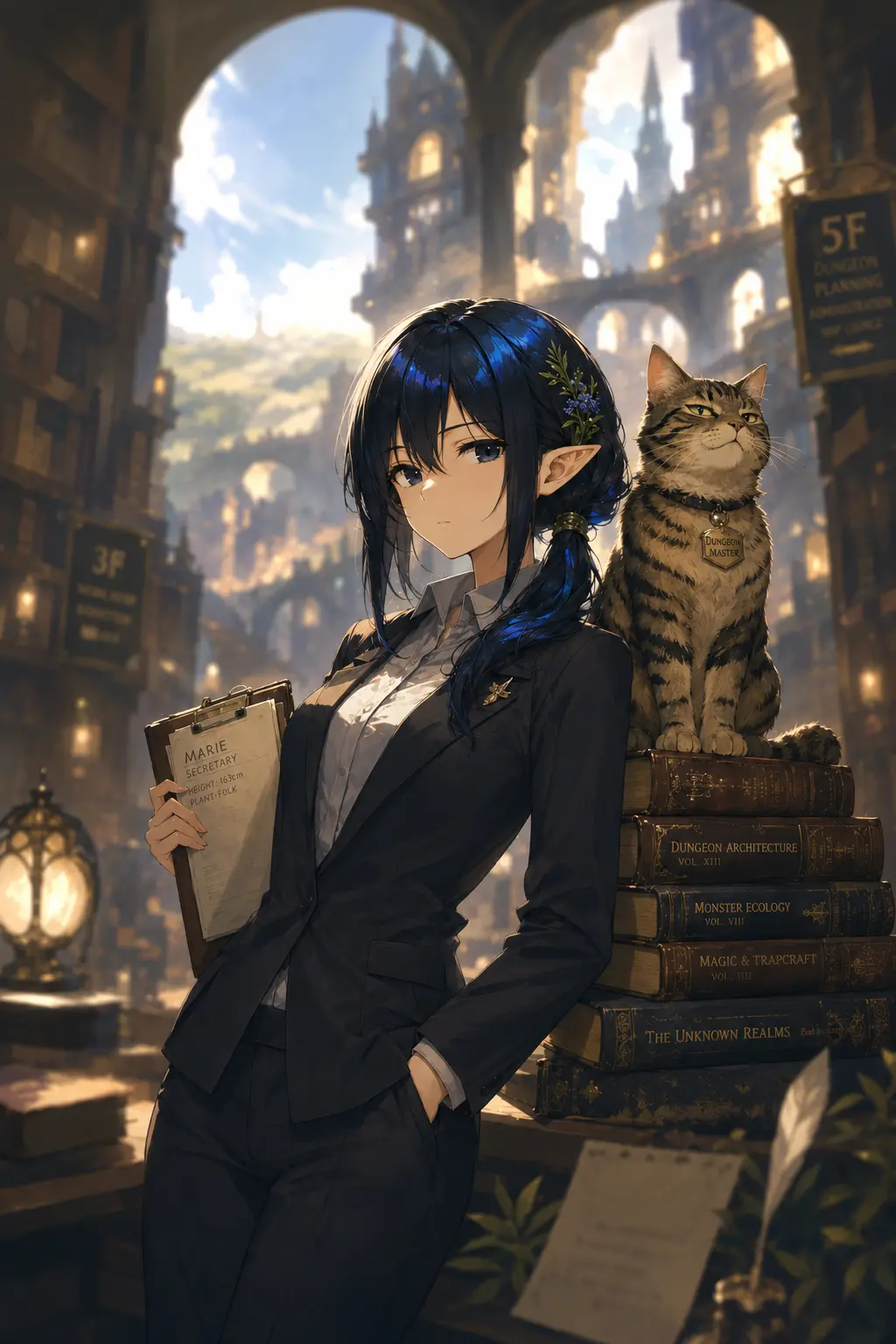
The One-Million-Chobu Reclamation Plan
Time for Rice Planting
[Outside the West Gate, West Bank of the Kamogawa]
The abundant water the dungeon supplied ran along the channels and filled the paddies.
"A journey of a thousand ri begins with a single step. A million chōbu begins with a single tan."
With Marie's word of greeting, the rice planting began. That said, growing the seedlings takes about thirty days, so today they would only plant the seedlings that had been prepared for the pond on Tier-Group 3, by way of practice.
Rice was a luxury crop grown in buckets, and the farmers had no idea how to raise it in a paddy. Taking advantage of that, they used a measuring rule to set the seedlings out in neat, straight rows, the "straight-row planting" method, though in a desert with few weeds or pests, the trouble of straight-row planting offered little benefit. They also tried dry-paddy direct seeding on an experimental basis, but which method suited this region's conditions remained an unknown.
"It's the same as planting them in a bucket, really," someone said.
"Three or four buckets to a single bowl of rice. None of it ever reaches our mouths."
"I heard this year they mean to make about a thousand chō of paddy. And eventually a million chō, they say."
"A million, is it. That's a bold figure to throw around. Enough for a million people, then."
Even an inferior field yielding one koku per tan would feed more than that. Such is the productive power of rice farming.
[Plaza Before the Tier-Group 3 Entrance]
"Forget tractors, there isn't so much as an ox or a horse."
"It can't be helped. Saitama was an overpopulated region with few draft animals, so this world has probably been shaped by that culture as well. On top of that, this area is a desert, so there's the further problem that there isn't enough fodder for livestock. But as for farm tools that don't require power, it's only that this dungeon lacks them; most of them already exist out in the world. As long as we make them, everyone will use them."
A hallmark of the Edo period was that family-run owner-farmers (the honbyakushō) possessed a wide variety of farm implements. The same held true in this world. The reason most folklore museums have a thousand-tooth thresher and a winnowing fan is that these were expensive, large-format tools, and so they were kept rather than thrown away.
"As long as we make them?"
"Yes. Their effectiveness is already known; it's simply that they can't be obtained. If this were some wholly unknown technology, the common folk in most worlds would be slow to accept it."
"So in terms of agricultural technology, the Edo period was quite advanced, then."
"It only lacked power and mechanization; technically it was at a fairly high level. As for crops, in this world too, just as in the Edo period, potatoes, sweet potatoes, squash, corn, and peanuts are at least known, whether or not they're widespread. The tomato is unpalatable, so it's kept only as an ornamental."
"So this world has a New World too, huh. Doesn't look like there's even a sea, though."
"There does seem to be no sea. Whether there once was one, or whether they were brought in from another world, I couldn't say."
"Still, when it comes to the tuber crops, we can't get hold of the superior otherworld varieties."
"Tubers are hard to attach as a magazine appendix, and this dungeon can only summon books. Strictly speaking, we can also summon library fixtures and things relating to the dungeon monsters' food, clothing, and shelter, but that doesn't include living things."
If a dungeon monster were a human, and one summoned fresh vegetables as foodstuffs, those vegetables would not be alive.
"I'd love a home-center dungeon. Or, hmm, isn't there a department-store dungeon somewhere? Like an Echigo-ya."
"Master, Echigo-ya is for Tokyo residents only. We can't get in… or rather, that's not the case, but a dungeon that convenient is too much to hope for. As I mentioned the other day, there's a library in Hokkaidō with an attached greenhouse, so if we summon that, we may eventually be able to obtain plants too."