

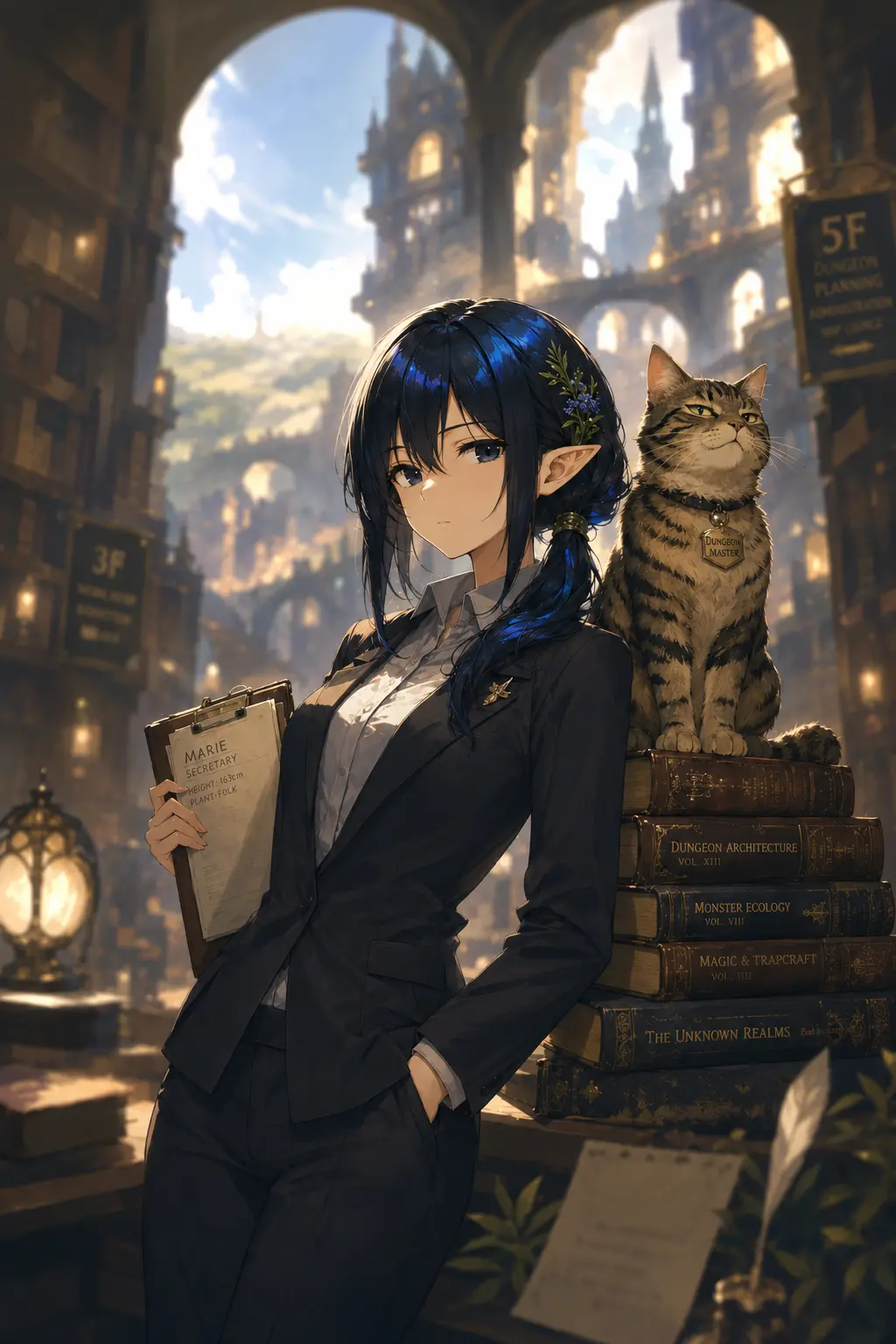
The Six-Party Conference
Negotiation Strategy
[Tier-Group 4, First Floor, Reception Room]
"Well then, once the envoys are all assembled, we'll have to discuss our policy going forward. Even if it comes to fighting Sō's expeditionary force next, that just means this dungeon gets a few more vacant rooms."
"The east was in disorder to begin with, but if Sō tips over too, then even in Musashi the pirates may multiply and refugees come flooding in. Fortunately, the east doesn't seem to have fallen into the great upheaval we'd feared."
"The aim of the conference is to make the neighboring states recognize this dungeon as an independent power."
"That none can lay a hand on us. That's what we want. And for that, what we need is the armed strength to defend ourselves, and the authority to make the surroundings hold their tongues."
"Having our self-defense capability recognized poses no problem. We have the proven record of having repelled Tsukuba Naiyaku-no-jō."
In truth, had the enemy general been competent, we couldn't have coped with him.
"Then what's left is authority, court rank. With no rank and no title, like Hiki Komori Niedo Saburō, nothing one says carries any weight."
Of course, "Saburō" is not a taboo name but a common name, so calling him Saburō is no discourtesy in itself. Note that in the case of Asura or beastfolk, there's no problem in calling them by their real names.
"Court rank, is it. It seems we can't exactly make a donation to the imperial court and be granted a rank, either."
Whether there even is an imperial court is unknown.
"In practical terms, since a provincial governor is of the fifth or sixth rank, we name ourselves to some suitable rank in that vicinity, and if it passes muster there's no problem. Naming oneself a Middle Captain of the Inner Palace Guards or a Provisional Middle Counselor, of course, would be laughed at as far too lofty."
"This being the Library-City Dungeon, let's style ourselves Director of Books, then."
The court ranks of a lord of a realm or a castellan are self-styled. Among the retainers, because the lord scatters writs of office and received titles are used freely, it's all quite a muddle.
"Now, as for conferring benefits on the neighboring states, in the short term, taking the surplus humans off their hands is probably best, I think. Humans have an abnormally high breeding rate, after all. And it strengthens this dungeon besides."
"Musashi, too, has too large a population and a shortage of food."
"Of course, in the long term, unless we do something about the population explosion itself, we'll be ruined even if we have a million chō of paddy and field. By Malthus's essay on population… no, by otherworld research, where constraints are few, a population doubles every twenty-five years. With a hundred thousand people, that's sixteenfold in a century, 1.6 million; roughly 400 million in three centuries; 100 billion in five; and after a thousand years, 100 quadrillion… I don't even want to think about it."
"Do they really increase that much?"
"They do, absent war, banditry, famine, or plague. That said, if we forced population limits now, an uprising would certainly break out, so this is something we can only deal with over time."
"Fundamentally, we mustn't do anything that would provoke an uprising. And since this dungeon can be seen even from afar, not only the envoys of each country but all manner of merchants, monks, mountain ascetics and itinerant shrine-maidens, mercenaries and adventurers, and spies, of course, will come, every sort of person. That'll make keeping order all the harder, so we'd best avoid the danger of touching off an uprising by doing anything foolish."
"True, shutting them out with a long wall enclosing even the farming districts would be difficult, and without ramparts, building a barrier on the road would only get bypassed."
"Besides, just by this dungeon mass-producing and exporting rice, the neighboring states profit."
"It's not that the dungeon controls distribution, but the tax rice is paid out as stipends and sold off for living expenses, and rice beyond the tax is sold as well. In the end, once rice production gets on track, a great deal of it will flow onto the market."
Paddy farmers sell their rice for farm tools, fertilizer, and living costs, and ordinarily eat the wheat of the off-season crop. Cash-crop farmers buy rice to pay as tax. The koku-yield of the Edo period was thirty million koku, but since a considerable share of the paddies was used for cash crops, the actual rice harvest was not even half that. The owner-farmers, of course, did not go hungry except in a famine.