
Interlude: Commentary
Commentary: World Affairs
In both technology and culture, the world stands at roughly the level of the Edo period, though it would seem there is no Edo. A handful of dungeons, the Library-City Dungeon among them, yield the products of advanced technology, but the lack of an industrial base means these can be neither mass-produced nor even maintained, so they have not come into general use.
● The Eight Provinces of Kantō
Also called the Bandō. The region in which the Library-City Dungeon stands.
[The Library-City Dungeon]
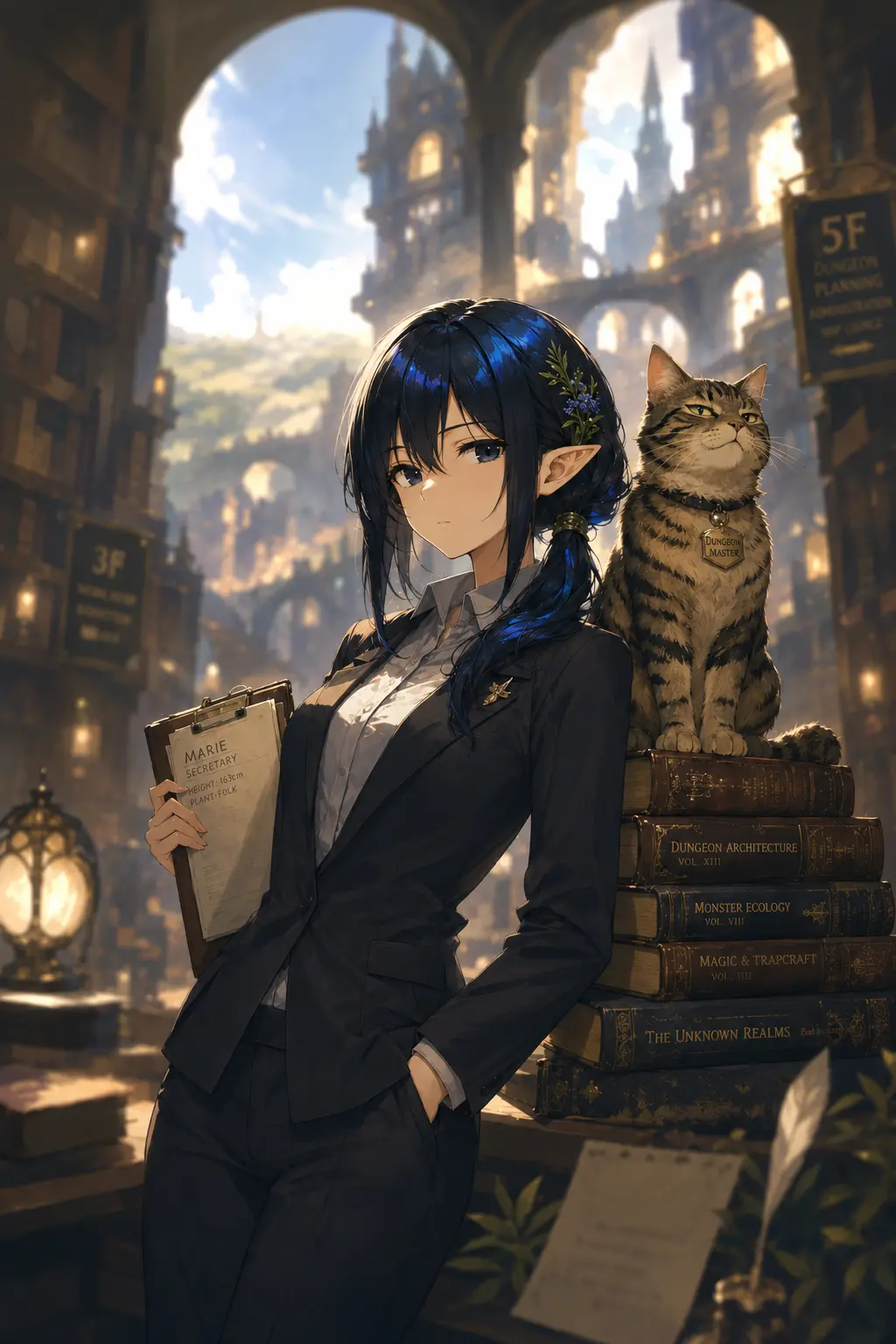
A tower-type dungeon rising into the stratosphere atop a hill of some hundred-odd meters, in the uninhabited wilderness of Adachi: a great stack of libraries piled one upon another.
Repeated dungeon disasters have made it grow enormous, and as its sphere of influence widens it is forming a vast belt of farming villages all around.
The inhabitants are mostly human, with a small number of Beasts and Asura. Population, about 70,000.
[The Land of Musashi]
Spreads west and south from the vicinity of the Library-City Dungeon. The nearest part to the Library-City Dungeon is Iruma. The capital is Fuchū in Tama; the lord is the Musashi-no-kami. District magistrates are stationed in each region, such as Iruma and Hiki. Some castles, like Matsuyama and Kawagoe, are governed not by magistrates but by castle-lords.
"Musashi" is written with borrowed characters and its origin is wholly unknown. As an insult it gets the gloss 穢し = musai, "filthy," and the like.
The inhabitants are mostly human. Population, about 1.6 million. As it is desert, productivity is poor and the population density low.
There are many dungeons in the mountainous region to the west, but the great majority are no different from natural caves.
[The Land of Sō]
Spreads out chiefly to the southeast of the Library-City Dungeon. The capital is Kōnodai in Katsushika; the lord is the Kazusa-no-suke.
The inhabitants are mostly human, with some Beasts and Asura. Population, about 1 million. The Chiba clan and the Yūki clan are here. The land stretches long to the north, south, and east, centered on Kōnodai.
Near Kōnodai there is a farm dungeon, the Nakayama Racecourse, but since its true nature is not in fact that of a farm, it is gradually going into decline.
In the east, at Iinuma, there is a large water-attribute dungeon that yields fish, so dried fish is famous there. Unfortunately the water is salt water, so it cannot be used for farming. The salt water that overflows from the dungeon has become a natural salt flat, but in this region salt is not a particularly precious commodity.
[The Land of Ke]
Lies to the north. The capital is Sōja in Gunma County; the lord is the Kōzuke-no-suke. There is a custom of permitting those especially accomplished in some single art to style themselves Kōzuke-no-suke.
The inhabitants are the people of Ke, that is, mostly Beasts. Population, about 1 million. The Utsunomiya clan and the Oyama clan are here. The land stretches long from east to west, and its northern side is a sparsely populated mountainous region.
In the east lies the vast salt land of the Nasu-Shiobara dungeon. To the south of it there is a dungeon that yields gyōza, but since these naturally will not keep, they are dried before shipping.
[The Eastern Land]
Lies to the east. Strictly speaking it is across the northern part of Sō, but the boundary is vague. Conditions are so chaotic that even the extent of the counties has become unclear. The rightful lord is the Hitachi-no-suke, but at present powerful figures style themselves so.
With the slaying of Tsukuba Naiyaku-no-jō, the chaos has grown still worse. The Oda clan and the Satake clan are here.
The inhabitants are mostly human, with some Beasts and Asura, though the east is almost entirely human. Population unknown (about 500,000 or so).
Because the land is barren, it is said that even with water, only soybeans will grow.
[The Land of Sumō]
Lies to the south of Musashi. It is not Sagami, but it does yield gazami (crabs). The capital is in Yorogi.
Population, about 350,000.
There is a forest dungeon, Tanzawa Hills, that yields timber, but it is full of unpleasant bloodsucking creatures.
[The Land of Awa]
Lies to the south of Sō. Culturally it is of the southern type, and is made up of many ethnic groups.
The inhabitants are human, Asura, and Beasts. The tanuki-beastfolk are famous. Population, about 500,000.
The chief products are sugar, citron, and dyes such as indigo. Some say its sweet potatoes are tastier than Kawagoe potatoes.
● Regions Outside the Eight Provinces of Kantō
[The Land of Kō]
Lies to the west of Musashi. From the standpoint of agriculture it is a poor land, riddled with endemic disease, but its mountain produce is abundant.
By headcount the inhabitants are mostly human, but it is the Pretas who thrive. Population, about 350,000.
[The Land of Shina]
A mountainous region to the west of Musashi.
Humans, Asura, Beasts, and Pretas all dwell here, but by headcount most are human. Population, about 900,000.
There are many dungeons, yielding foodstuffs, timber, mineral resources, and the like, so there are many adventurers too.
[The Land of Koshi]
Lies still further north of the Land of Ke, beyond the mountains.
Its territory is vast and its population numbers some 3 million, but it has little sense of unity.
There are several dungeons that yield rice, but with no sea and thus no water transport to use, rice is a precious commodity in the Eight Provinces of Kantō.
● Distant Dungeons
[Umeda, the Mercantile City]
A vast dungeon city far to the west. It has a great many associations such as merchants' stock guilds, and is administered by representatives of the merchants. Each tier-group is on the order of a kilometer in diameter.
Each tier-group has a great many Core Rooms styled "stationmaster's offices," and the dungeon cannot be conquered without seizing all the cores of all the tier-groups at once.
First tier-group, "Umeda."
The surface is a Meiji-Taishō-style cityscape. The underground is a labyrinth, and underground alone there are 20,000 people. Because railway stations that were never built in some worlds (the Shinkansen Osaka Station, the Han-Na Electric Railway, the Han-Ki Railway, and so on) have been incorporated into it, the maze is bizarrely complex.
Second tier-group, "Nagoya."
Comparatively small in scale. It lies beneath the first tier-group. Its "surface section" has, among a wooden residential district, several high-rise buildings standing over 200 meters tall, reaching the ceiling. The ceiling is underground, yet forms a glowing "sky."
Third tier-group, "Ikebukuro."
It has four department stores, one to each of the cardinal directions, but it is a confusing tier-group in that their names and their positional relationships are reversed.
Fourth tier-group, "Shinjuku."
Simply enormous, it bewilders people by its sheer breadth.
Fifth tier-group, "Shibuya."
A complex three-dimensional maze. Because the savage Tōyoko Kids (not Tō-yoko) appear on the fifth basement floor of its lower levels, no one has ever traversed it, and below that again, the sixth tier-group remains unknown, even as to whether it exists at all.
[Asuka, the Temple of Stone]
Located comparatively near Umeda the Mercantile City, about two days off.
The dungeon is inhabited by Asura that are not dungeon monsters, and they carry out sacrifice-hunts. On the "Oni-no-Manaita" they use obsidian knives to cut out a living heart, and let the blood flow down the channel of the "Sakafune-ishi."
It is a rare dungeon in that it possesses a means of attacking beyond its sphere of influence. By offering up a great many sacrifices at the "Kameishi," it can form a "Kame-no-se" against a hostile city and sink it into a quagmire.